Rhodamine B 500% - Basic Violet 10 - Fluorescent Dye
RHODAMINE B - 500%
Technical grade
- IUPAC Name: [9-(2-carboxyphenyl)-6-diethylamino-3-xanthenylidene]-diethylammonium chloride
- Other names: Rhodamine 610, C.I. Pigment Violet 1, Basic Violet 10, C.I. 45170
- Formula: C28H31ClN2O3
- CAS No: 81-88-9
- Mol Wt: 479.02
- Solubility in water: ~50 g/l
- Absorption Max: 542-556nm
- Excitation wavelength: 514nm
- Solubility: Rhodamine B is soluble in ethanol, methyl cellosolve, acetic acid, and many polar solvents. It is only slightly soluble in acetone.
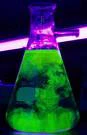
Rhodamine B is often used as a tracer dye within water to determine the rate and direction of flow. Rhodamine dyes fluoresce and can thus be detected easily using fluorometers.
Rhodamine B is a recognised and approved tracer dye used by water authorities. It is used at low levels of 1kg per million litres of water (i.e. 1ppm) which permits visual determination of water flow. At these levels it is not considered to be harmful to fish. Below is a link to recent research into this subject:
http://www.fws.gov/…orescein.pdf
Rhodamine dyes are used extensively in biotechnology applications such as fluorescence microscopy, flow cytometry, fluorescence correlation spectroscopy and ELISA.
Rhodamine B is used in biology as a staining fluorescent dye, sometimes in combination with auramine O, as the auramine-rhodamine stain to demonstrate acid fast organisms, notably mycrobaerium. Rhodamine B is tunable around 610 nm when used as a laser dye. Its luminescence quantum yield is 0.65 in basic ethanol, 0.49 in ethanol 1.0 and 0.68 in 94% ethanol. The fluorescence yield is temperature dependent.
Other Uses: Colouring for cleaning products and detergents.
PLEASE NOTE: This product is not for human or animal consumption.
Original: $35.56
-65%$35.56
$12.45Product Information
Product Information
Shipping & Returns
Shipping & Returns
Description
RHODAMINE B - 500%
Technical grade
- IUPAC Name: [9-(2-carboxyphenyl)-6-diethylamino-3-xanthenylidene]-diethylammonium chloride
- Other names: Rhodamine 610, C.I. Pigment Violet 1, Basic Violet 10, C.I. 45170
- Formula: C28H31ClN2O3
- CAS No: 81-88-9
- Mol Wt: 479.02
- Solubility in water: ~50 g/l
- Absorption Max: 542-556nm
- Excitation wavelength: 514nm
- Solubility: Rhodamine B is soluble in ethanol, methyl cellosolve, acetic acid, and many polar solvents. It is only slightly soluble in acetone.
Rhodamine B is often used as a tracer dye within water to determine the rate and direction of flow. Rhodamine dyes fluoresce and can thus be detected easily using fluorometers.
Rhodamine B is a recognised and approved tracer dye used by water authorities. It is used at low levels of 1kg per million litres of water (i.e. 1ppm) which permits visual determination of water flow. At these levels it is not considered to be harmful to fish. Below is a link to recent research into this subject:
http://www.fws.gov/…orescein.pdf
Rhodamine dyes are used extensively in biotechnology applications such as fluorescence microscopy, flow cytometry, fluorescence correlation spectroscopy and ELISA.
Rhodamine B is used in biology as a staining fluorescent dye, sometimes in combination with auramine O, as the auramine-rhodamine stain to demonstrate acid fast organisms, notably mycrobaerium. Rhodamine B is tunable around 610 nm when used as a laser dye. Its luminescence quantum yield is 0.65 in basic ethanol, 0.49 in ethanol 1.0 and 0.68 in 94% ethanol. The fluorescence yield is temperature dependent.
Other Uses: Colouring for cleaning products and detergents.
PLEASE NOTE: This product is not for human or animal consumption.